
Ethereum Mixer vs Bitcoin Tumbler: Which Privacy Tool Actually Protects You in 2026?
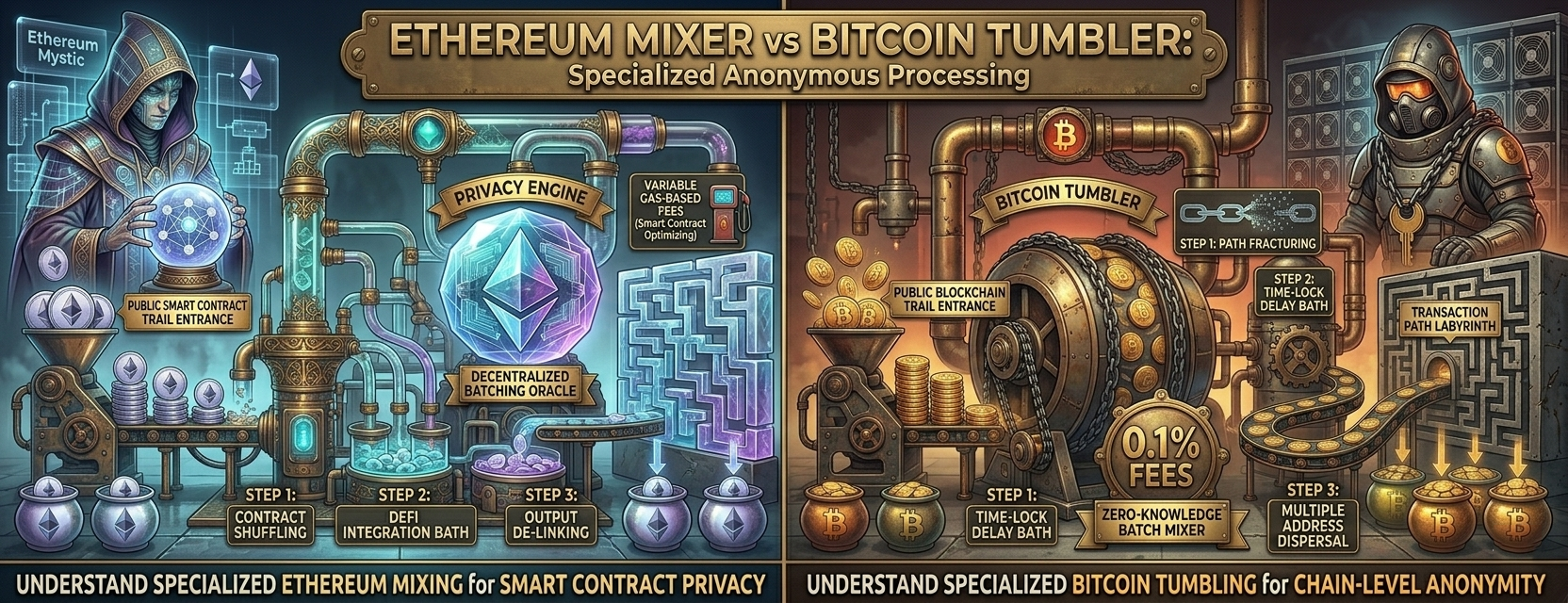
Bitcoin and Ethereum remain the two largest cryptocurrencies by market cap, yet they handle privacy very differently due to their underlying architectures. Bitcoin’s blockchain is simple and UTXO-based, while Ethereum is account-based with smart contracts and higher activity levels.
When it comes to reclaiming privacy, users often ask: Should I use a Bitcoin tumbler or an Ethereum mixer? Which one actually delivers stronger protection in 2026?
In this comparison, we break down the key differences, strengths, and limitations of each, and show why a modern non-custodial multi-coin mixer often provides the best of both worlds.
Why Privacy Tools Matter for BTC and ETH in 2026
Both blockchains are fully transparent. Every transfer is publicly visible forever. Chain analysis companies link addresses to identities through exchange KYC data, clustering heuristics, and behavioral patterns.
A Bitcoin tumbler or Ethereum mixer breaks these links by pooling and randomizing funds. However, the effectiveness depends on liquidity depth, mixing techniques, and how well the tool handles the specific chain’s characteristics.
Bitcoin Tumbler Explained
A Bitcoin tumbler (also called a Bitcoin mixer) is designed specifically for BTC. Traditional methods included centralized services or CoinJoin-style protocols (like those in Wasabi or Samourai Wallet).
How it works:
- Your BTC is broken into small fragments.
- These fragments are mixed with coins from many other users in liquidity pools.
- Clean BTC is sent to your new address(es), severing the direct on-chain trail.
Strengths in 2026:
- Mature ecosystem with well-tested privacy techniques.
- UTXO model allows natural fragmentation.
- Often benefits from high Bitcoin liquidity.
Limitations:
- Slower confirmations during network congestion.
- Many dedicated Bitcoin tools require specific wallet setups.
- Limited to BTC only (no easy multi-coin support).
Ethereum Mixer Explained
An Ethereum mixer handles ETH and ERC-20 tokens (such as USDT or USDC). Because Ethereum uses an account-based model and supports smart contracts, mixers can leverage more advanced techniques, though they must deal with higher gas fees and faster transaction times.
How it works:
- Similar fragmentation and pooling process.
- Funds are routed through liquidity pools or automated smart contract logic.
- Clean ETH or tokens are delivered to your specified address(es).
Strengths in 2026:
- Faster transaction finality compared to Bitcoin.
- Native support for tokens (stablecoins are popular for mixing).
- Can integrate more sophisticated obfuscation via contract logic.
Limitations:
- Higher and more variable gas fees can increase effective mixing cost.
- Account-based model makes address clustering slightly different.
- Past high-profile Ethereum mixers (like older versions of Tornado Cash) faced regulatory pressure, pushing users toward compliant or non-custodial alternatives.
Head-to-Head: Ethereum Mixer vs Bitcoin Tumbler
| Aspect | Bitcoin Tumbler | Ethereum Mixer | Winner / Notes |
|---|---|---|---|
| Speed | ~5–60+ minutes (depends on confirmations) | Often faster finality | Ethereum (but depends on gas) |
| Fees | Usually flat or low % + network fees | 0.1% + potentially higher gas | Bitcoin (more predictable) |
| Liquidity | Very high for BTC | High, especially for ETH & stablecoins | Tie (deep pools matter more) |
| Unlinkability | Strong with good fragmentation | Strong with smart routing | Tie – depends on the mixer quality |
| Multi-Address Support | Common | Common | Tie |
| Custom Delays | Available in advanced tools | Available | Tie |
| Ease of Use | Varies (some need special wallets) | Often simpler web-based | Ethereum (for beginners) |
| Multi-Coin Support | Usually BTC only | ETH + many ERC-20 tokens | Ethereum |
Key takeaway: Neither is universally “better.” Bitcoin offers rock-solid, battle-tested privacy for pure BTC holders. Ethereum provides speed and token flexibility but can incur higher variable costs.
The real differentiator in 2026 is the mixer itself — not just the chain. A high-quality non-custodial platform with deep liquidity pools and intelligent routing outperforms chain-specific legacy tools.
Why Mix My Crypto Excels for Both Bitcoin and Ethereum Mixing
Mix My Crypto is a modern non-custodial multi-coin mixer that supports both Bitcoin and Ethereum (plus USDT, USDC, and many others) under one roof.
Standout features in 2026:
- Flat 0.1% fee across all supported assets — transparent and among the lowest available.
- Fully non-custodial — you never lose control; no accounts or KYC required.
- Deep liquidity pools with proprietary smart routing for strong unlinkability on both BTC and ETH.
- Custom delays — add timing obfuscation to disrupt analysis on either chain.
- Multi-address splitting — automatically distribute clean funds across up to 4 fresh addresses.
- Fast processing — most mixes complete in approximately 5 minutes, depending on network conditions.
Whether you need to tumble Bitcoin or mix Ethereum and stablecoins, you get the same high privacy standards, minimal fees, and user control without switching platforms.
Which Should You Choose in 2026?
- Choose a Bitcoin tumbler if you primarily hold and transact in BTC and want maximum liquidity for that asset.
- Choose an Ethereum mixer if you work with ETH, stablecoins, or need faster confirmations and token flexibility.
- Choose a unified non-custodial platform like Mix My Crypto if you want the best of both worlds — seamless switching between coins, consistent low fees, and powerful features without compromise.
For most users, a versatile, low-fee, non-custodial mixer delivers superior real-world privacy while simplifying the process.
Ready to Mix Bitcoin or Ethereum Privately?
Don’t settle for outdated or chain-limited tools. Protect your funds with a next-generation privacy solution that works across major cryptocurrencies.
Start mixing privately today at: mixmycrypto.net/mixer
Break transaction trails on Bitcoin, Ethereum, or any supported asset, all with 0.1% fees and full control.
You agree that you will not use, encourage, or support the use of the Mix My Crypto service or website for any purposes other than those expressly permitted under our Terms and Privacy Policy.